By Chad Lesausky
chad@sunriseclassroom.ai
X.com: @clesausky
LinkedIn
Looking for a guest speaker to do an AI talk at your school’s next faculty meeting? Send us an email: support@sunriseclassroom.ai
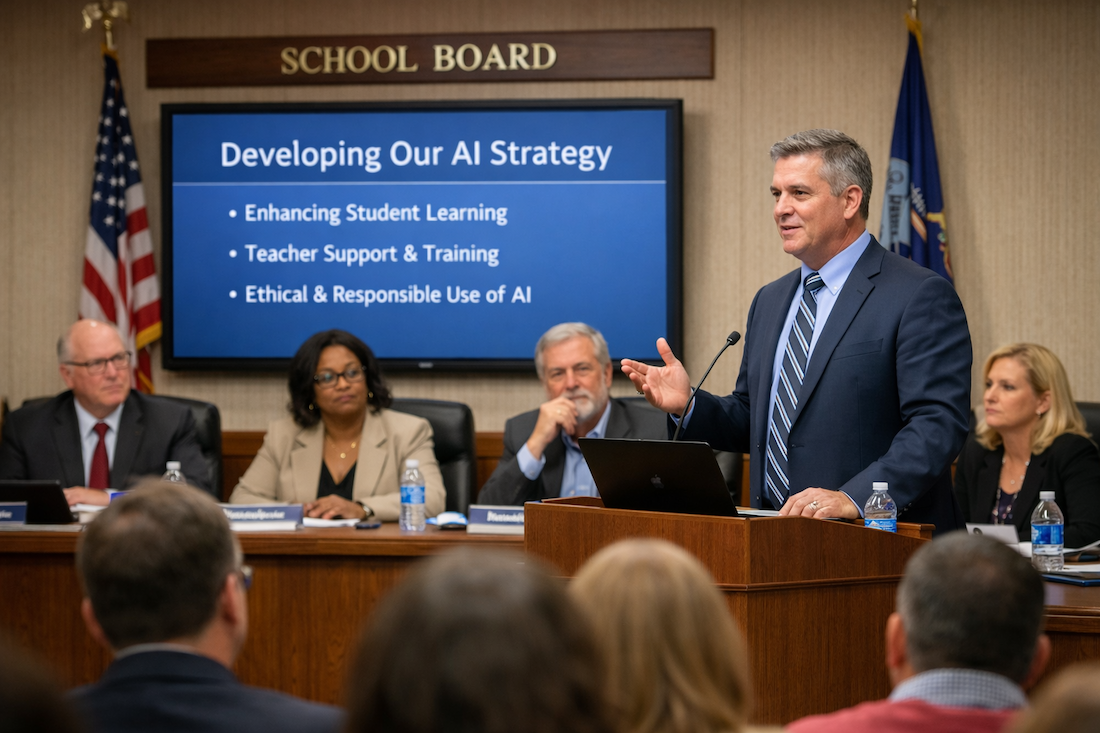
There is a moment in every era when leadership is tested, not by crisis alone, but by possibility. Public education stands at one of those moments now. Artificial intelligence is no longer a speculative technology. It is already reshaping how work gets done, how decisions are made, and how institutions adapt or fail to adapt to change. And as school boards across the country begin the serious work of selecting their next superintendents, one question looms larger than most:
Does this leader understand how to guide a school system through the age of AI?
This is not a question about gadgets or buzzwords. It is a question about strategy, stewardship, and trust.
Why AI Literacy Is Now a Core Superintendent Competency
Over the last decade, districts have invested heavily in instructional technology. According to the National Center for Education Statistics, over 90% of U.S. public schools now provide digital devices to students in some capacity. Yet despite these investments, outcomes have often lagged expectations.
https://www.edweek.org/technology/what-the-massive-shift-to-1-to-1-computing-means-for-schools-in-charts/2022/05
AI changes the equation. Unlike prior edtech waves, AI does not merely digitize existing workflows, it restructures them. Lesson planning, professional development, assessment analysis, staffing models, compliance reporting, and even family communication are being fundamentally altered.
McKinsey estimates that up to 30% of tasks performed by educators and administrators could be automated or augmented by AI by 2030.
https://www.mckinsey.com/industries/education/our-insights/how-artificial-intelligence-will-impact-k-12-teachers
For a superintendent, this raises a basic but urgent question:
If AI is changing how work happens, do we have a strategy or are we reacting piecemeal?
The Hidden Risk: Delegating AI Strategy Downward
In too many districts, AI decisions are being made in fragments:
- A curriculum department pilots an AI lesson tool
- IT evaluates a chatbot for help desk support
- HR experiments with resume-screening software
- A single enthusiastic principal tries something new
None of this is inherently wrong. But without district-level leadership, it becomes dangerous.
“The use of EdTech has the potential not only to accelerate progress and increase equity … but also to cause unintentional harm and increase inequity … This is a particular risk in the rush to deploy technology in times of urgency and crisis.”
https://docs.edtechhub.org/lib/PBXBB7LF/download/VN8LLKXD/Problem%20Analysis_Technology%20in%20Education_Revised%20Final_1.pdf
AI amplifies this risk. When left unmanaged, it can:
- Create inconsistent instructional expectations
- Introduce data-privacy vulnerabilities
- Undermine teacher trust
- Lock districts into poorly aligned vendor contracts
A superintendent who treats AI as “someone else’s domain” is not being cautious, they are being negligent.
What Boards Should Be Asking Superintendent Candidates
School boards do not need candidates who can code. They need leaders who can ask the right questions and set the right conditions.
Here are five questions every board should be asking:
- What is your district-wide AI strategy, not just pilots?
A credible leader should articulate how AI supports instructional quality, teacher development, and operational efficiency as a coherent system. - How will you protect student and staff data?
Since 2005, educational institutions in the United States have experienced 3713 data breaches, impacting over 37.6m records. AI governance cannot be an afterthought. https://www.infosecurity-magazine.com/news/data-breaches-us-schools-37m - How will teachers be supported, not replaced?
Many experts agree that edtech is most effective when it is used to augment the work of great teachers, not replace it.
https://www.edsurge.com/news/2026-01-14-i-ve-seen-great-teaching-up-close-and-tech-isn-t-what-makes-it-happen
- How will equity be safeguarded?
AI systems reflect the assumptions embedded in them. Leadership must ensure access, training, and oversight are distributed fairly. - How will success be measured?
Not adoption metrics. Outcomes: teacher retention, instructional coherence, compliance efficiency, and student learning growth.
A superintendent who cannot answer these questions plainly is not ready for this moment.
AI Strategy Is a Leadership Signal
Here’s the truth we don’t say often enough:
AI strategy is not about technology, it’s about institutional maturity.
A superintendent who leads on AI sends a signal:
- That the district values teacher time
- That compliance can be smarter, not heavier
- That innovation does not mean chaos
- That change can be managed with integrity
Research from the Learning Policy Institute shows that districts with coherent professional learning systems experience significantly lower teacher turnover—up to 15 percentage points lower in high-need schools (https://learningpolicyinstitute.org/product/teacher-turnover-report).
AI, when deployed strategically, strengthens those systems. When deployed poorly, it fractures them.
The Superintendent as Steward of the Future
Leadership in public education has always been about balancing urgency with patience, innovation with stability, and vision with trust.
AI does not change that responsibility, it intensifies it.
The next generation of superintendents will not be remembered for the tools they purchased, but for the systems they built, the people they empowered, and the choices they made when the path forward was uncertain. This is not a moment for fear. It is a moment for thoughtful courage. The districts that get superintendent selection right, those that prioritize strategic clarity over surface-level innovation, will not only adapt to the future. They will help shape it.
Need help developing lessons within a UDL framework? Want to incorporate AVID strategies into your next lesson? Try Lesson Optimizer by Sunriseclassroom.ai.
Check out the video tutorial >>> HERE