By Chad Lesausky
chad@sunriseclassroom.ai
X.com: @clesausky
LinkedIn
Looking for a guest speaker to do an AI talk at your school’s next faculty meeting? Send us an email: support@sunriseclassroom.ai
The First 10 Instructional Moves That Help New Teachers Improve Faster Than Experience Alone
Teaching has always been an act of hope. Classrooms fill each fall with educators who believe their work can shape lives, strengthen communities, and widen opportunity. Early-career teachers bring energy and conviction, yet talent alone does not guarantee rapid growth. Progress accelerates when novices practice a small number of high-leverage moves with clarity, feedback, and purpose. Research and lived experience both point to a truth worth stating plainly. Improvement comes faster from intentional practice than from the passage of time.
What follows are ten instructional moves that help new teachers improve faster than experience alone. Each move reflects disciplined habits observed in effective classrooms and supported by evidence.
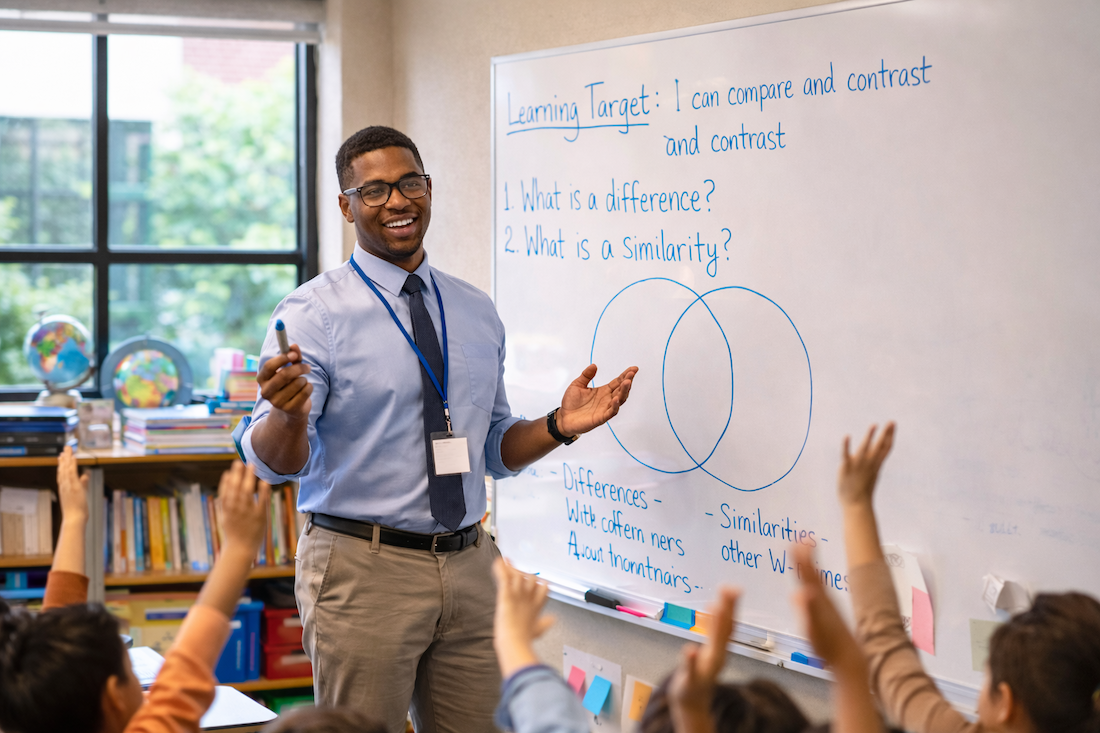
1. Make learning intentions explicit
Clarity anchors instruction. Lessons improve when teachers articulate what students will learn and why it matters. Clear learning intentions act as a compass for both teacher and students, shaping instructional choices and signaling what success looks like before the work begins.
2. Design tasks before activities
Strong instruction begins with the cognitive demand students must meet. Teachers who plan tasks around thinking, not coverage, see faster gains in student understanding. Purposeful task design narrows the gap between intent and outcome.
3. Check for understanding early and often
Formative assessment guides instruction in real time. Dylan Wiliam reminds educators that, “Formative assessment functions formatively to the extent that evidence about student achievement is elicited, interpreted, and used by teachers, learners, or their peers to make decisions about the next steps in instruction that are likely to be better, or better founded, than the decisions they would have made in the absence of that evidence.” -Dylan Wiliam, Embedded Formative Assessment
https://cloudfront-s3.solutiontree.com/pdfs/Reproducibles_EFA/The-Main-Idea-Embedded-Formative-Assessment-March-2013.pdf
4. Model thinking aloud
Students benefit when teachers externalize reasoning. Novices grow when they practice narrating decisions, problem-solving steps, and moments of uncertainty. Metacognitive modeling builds student independence while sharpening teacher precision.
5. Use wait time strategically
Silence can be instructional. Allowing three to five seconds after posing a question increases the quality of student responses and participation. Thoughtful pacing shifts classrooms from rapid recall to deeper reasoning. “If teachers can increase the average length of the pauses … after a question (wait time 1) and, even more importantly, after a student response (wait time 2) to 3 seconds or more, there are pronounced changes (usually regarded as improvements) in student use of language and logic as well as in student and teacher attitudes and expectations.” — Mary Budd Rowe research summary on wait time.
https://www.kent.edu/ctl/wait-time-making-space-authentic-learning?utm_source=chatgpt.com
6. Anchor lessons in student talk
Learning accelerates when students do the cognitive heavy lifting. Structured discussion routines help teachers practice listening for understanding. Classrooms that value student discourse surface misconceptions quickly and create shared ownership of learning.
7. Provide feedback that is timely and specific
Timely and specific feedback matters because it helps students understand what they are doing well and what they need to adjust while the learning is still unfolding. When feedback arrives close to the moment of practice, students are more likely to connect it to their thinking, apply it immediately, and avoid reinforcing misconceptions. When feedback is specific it builds trust, signaling that effort leads to growth and that improvement is possible through specific, actionable next steps.
8. Rehearse transitions and routines
Instructional minutes matter. Novice teachers who deliberately practice routines reclaim time and attention. Consistent procedures reduce cognitive load for students and free teachers to focus on instruction. “Students require support to learn and practise each step of a routine, as routines must be taught, rehearsed and reinforced in order to be learned,” because “well-established routines enable students to independently follow them with little involvement from the teacher, reducing interruptions and increasing teaching time.”
https://www.edresearch.edu.au/summaries-explainers/explainers/teaching-routines-their-role-classroom-management?utm_source=chatgpt.com
9. Reflect with evidence, not instinct
Growth accelerates when reflection moves beyond feelings. New teachers benefit from reviewing student work, transcripts of classroom dialogue, or short lesson clips. Evidence-based reflection transforms intuition into insight.
10. Seek coaching that is developmental, not evaluative
Mentoring matters when it feels safe and specific. “In FUSD, coaches practice “active coaching” strategies to model instruction and support real-time adjustments during a lesson, rather than waiting until afterward to debrief and plan for change. To maintain trust, mentors discuss these strategies in advance so teachers clearly understand how and when in-the-moment coaching interactions will occur.” -New Teacher Center
https://newteachercenter.org/resources/mentoring-for-a-changing-teacher-workforce/?utm_source=chatgpt.com
Teaching excellence rarely emerges from trial and error alone. Progress depends on deliberate practice, structured feedback, and a belief that improvement is possible now, not someday. These ten moves do not represent a checklist for perfection. They represent a starting point for growth.
New teachers deserve more than survival. Schools that invest in these practices send a clear message. Teaching is a craft worth developing with care, evidence, and hope. Students feel the difference when educators improve faster than experience alone ever could.
Need help developing lessons within a UDL framework? Want to incorporate AVID strategies into your next lesson? Try Lesson Optimizer by Sunriseclassroom.ai. Check out the video tutorial >>>HERE