Looking for a guest speaker to do an AI talk at your school’s next faculty meeting? Send us an email: support@sunriseclassroom.ai
The Myth of “Classroom Management First” and What Actually Helps New Teachers Early On
In nearly every conversation about supporting new teachers, a familiar refrain appears: focus on classroom management first. Control the room. Establish authority. Do not smile until December. The message is clear and well-intentioned. If students are not orderly, nothing else can follow.
This advice contains a kernel of truth. Learning requires structure. Young people deserve environments that feel predictable and safe. A teacher who cannot establish routines will struggle to make space for curiosity or intellectual risk-taking.
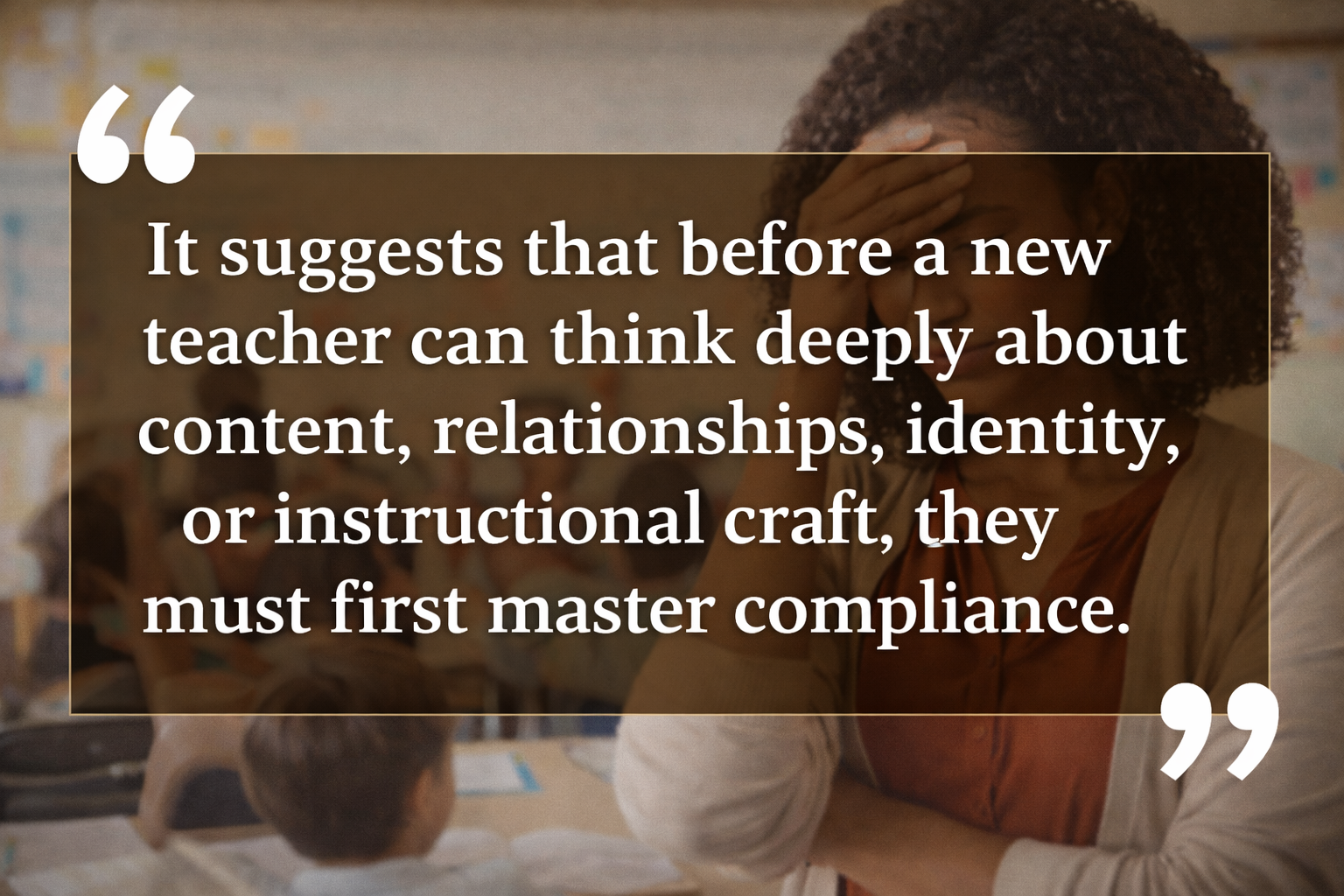
Yet the mantra of “classroom management first” has quietly hardened into something unhelpful. It suggests that before a new teacher can think deeply about content, relationships, identity, or instructional craft, they must first master compliance. It frames the first months of teaching as a battle for control rather than the beginning of a professional journey.
That framing shapes how new teachers see themselves. When management is treated as the gatekeeper skill, early missteps feel like moral failings. A lesson that falls flat becomes proof that one does not belong. A noisy transition becomes evidence of weakness. The teacher’s inner narrative shifts from growth to survival.
Such a narrative narrows the profession at precisely the moment it should be expanding.
Classroom management is not a prerequisite to good teaching. It is an outcome of good teaching, built gradually through clarity, consistency, and trust. Students respond not only to rules, but to purpose. They test boundaries not only because they can, but because they are unsure whether the adult in front of them sees them, believes in them, and knows where the lesson is headed.
New teachers need something more foundational than a set of behavioral techniques. They need coherence.
Coherence means understanding why a lesson matters, how each segment fits together, and what success looks like for students. It means knowing what to do when confusion appears, rather than interpreting confusion as defiance. It means possessing a small repertoire of high-leverage instructional moves that can be practiced, refined, and improved.
Clarity reduces chaos more reliably than charisma ever could.
When a teacher begins a class with a crisp objective and a clear model of what strong work looks like, many behavioral problems evaporate. When transitions are rehearsed and timed with intention, students sense that the room has a rhythm. When feedback is specific and immediate, students understand that effort is visible and improvement is possible.
Students do not need perfection. They need direction.
Research on early-career teacher retention consistently points to a simple insight: teachers who receive high-quality feedback tied to their daily practice grow faster and stay longer. Support that is concrete, timely, and anchored in real classroom moments builds efficacy. Generic advice about “being firm” does not.
Feedback that says, “When you paused after asking that question, three more hands went up,” creates a pathway forward. Feedback that says, “Try narrating the positive before correcting,” offers an actionable experiment for tomorrow. Growth becomes visible. Management improves as a byproduct of instructional precision.
Relationships matter just as much. Students comply for authority. They commit for belonging.
A new teacher who learns students’ names quickly, who references their interests, who communicates belief in their capacity, lays a foundation that no seating chart can substitute. Authority grounded in respect feels different from authority grounded in fear. One builds long-term influence. The other produces temporary quiet.
Too often, induction programs and veteran advice compress the complexity of teaching into a single dimension. New teachers are handed binders of behavior strategies while their intellectual and creative capacities are treated as secondary. The implication is subtle but powerful: master control first, then you may think about inspiration.
Such sequencing misunderstands the nature of learning communities.
Great classrooms are not quiet because students are managed. They are purposeful because students are engaged. Engagement flows from meaningful tasks, thoughtful scaffolding, and a teacher who can see patterns in student thinking. Engagement, in turn, strengthens management. The two are intertwined, not hierarchical.
Early support should therefore focus on three levers.
First, help new teachers design tight, well-structured lessons. A lesson with a clear opening, guided practice, checks for understanding, and a purposeful close reduces ambiguity. Ambiguity invites off-task behavior. Structure invites participation.
Second, build feedback loops that are frequent and humane. Observation followed by rapid, bite-sized coaching accelerates growth. Reflection tied to video or specific artifacts sharpens professional vision. Improvement compounds when it is measurable.
Third, cultivate professional identity. New teachers should see themselves not as disciplinarians-in-training, but as developing experts in student learning. Identity shapes behavior. A teacher who believes they are becoming skilled at diagnosing misconceptions approaches disruption differently than one who believes they are failing at control.
None of this minimizes the reality that classrooms can be difficult places. Students bring complex histories. Systems impose pressures. Time feels scarce. Discipline challenges are real.
What changes the equation is the lens through which those challenges are interpreted.
When the narrative shifts from “I must manage before I teach” to “I am learning to design, respond, and connect,” the emotional load lightens. The teacher begins to notice small wins. The room feels less like a battleground and more like a workshop.
New teachers deserve more than survival strategies. They deserve systems that accelerate mastery.
The myth of “classroom management first” persists because it promises certainty. Control feels concrete. Techniques feel transferable. Growth, by contrast, is iterative and sometimes messy.
Teaching has always required patience with complexity. Early-career educators thrive when complexity is acknowledged rather than flattened. They improve fastest when they are coached on the craft of learning design, supported in building relationships, and given feedback that treats them as capable professionals.
Classroom management matters. It simply does not stand alone.
When we invest in coherence, clarity, feedback, and identity, management improves organically. Students sense competence. Teachers feel progress. Classrooms become places where order and inspiration coexist.
The real first step is not control. The real first step is growth.
Need help developing lessons within a UDL framework? Want to incorporate AVID strategies into your next lesson? Try Lesson Optimizer by Sunriseclassroom.ai.