Using AI to Reduce Student Screen Time: Reclaiming Human Attention in a Digital Age
There is something deeply ironic about using artificial intelligence to get kids off screens. That’s like hiring a personal trainer who lives at a donut shop.
Looking for a guest speaker to do an AI talk at your school’s next faculty meeting? Send us an email: support@sunriseclassroom.ai
There is something deeply ironic about using artificial intelligence to get kids off screens. That’s like hiring a personal trainer who lives at a donut shop. It sounds suspicious from the jump. The pitch goes, “We’re going to use more technology to fix the fact that there’s too much technology.” Sure. That makes total sense. What could possibly go wrong?
Still, here we are.
Every adult I know complains about how much time kids spend staring at glowing rectangles. Teachers complain. Parents complain. Politicians complain. The kids are too busy scrolling to complain, which is probably why they’re winning. Meanwhile, schools are buying Chromebooks like they’re stocking up for the apocalypse.
The conversation usually goes one of two ways. One camp says technology is destroying attention spans and melting brains. The other camp says technology is the future and anyone who disagrees probably still owns a fax machine. Both camps are exhausting. Neither one is asking the more interesting question: what if AI could help us use less screen time instead of more?
The key difference is whether the screen is the destination or just the tool.
Most edtech treats the screen like Vegas. Lights flashing. Points popping. Badges raining down like confetti. Every lesson feels like a slot machine. Pull the lever, see if you get a dopamine hit. Teachers end up babysitting a dashboard instead of actual human beings. Kids start thinking learning is supposed to feel like a mobile game designed by a marketing intern.
AI does not have to work that way.
Imagine AI that does the boring stuff behind the scenes. The grading. The sorting. The pattern recognition. The “Which kids are confused about fractions but pretending they’re fine?” detective work. That work eats teacher time. Teacher time is the only thing that actually reduces screen time, because a human teacher standing in front of you is way harder to scroll past.
If AI can cut grading time in half, that frees up minutes for discussion. Discussion does not require a screen. If AI can analyze student writing and flag misconceptions, the teacher can pull a small group. Small groups involve actual talking. Talking involves eye contact. Eye contact tends to reduce TikTok usage.
The screen becomes the diagnostic machine, not the classroom.
There is a big difference between a kid staring at a screen consuming content and a teacher glancing at a dashboard to decide what conversation to have next. One is passive. The other is strategic. One shrinks attention. The other amplifies it.
Schools could use AI to compress feedback cycles. Quick feedback means students spend less time clicking through endless practice problems. The goal becomes precision instead of volume. Ten targeted problems beat fifty random ones. Fifty random ones keep the device open longer. Devices open longer turn into wandering. Wandering turns into Minecraft.
AI could also help teachers plan more efficient lessons. If a system can suggest a tight, well-sequenced activity, teachers waste less time fumbling through five different browser tabs. When the plan is clear, the laptop closes sooner. Closed laptops are undefeated.
There is another angle nobody likes to admit. Teachers are exhausted. When teachers are tired, screens are tempting. A video buys you ten quiet minutes. A digital worksheet keeps everyone busy. Busy feels productive even when it isn’t. AI that reduces teacher cognitive load could indirectly reduce the temptation to default to digital babysitting.
Less friction for adults equals fewer screens for kids.
This only works if schools resist the urge to turn AI into another flashy student-facing platform. The moment it becomes “Log in to your AI companion and chat for forty minutes,” the whole thing collapses. That is not reducing screen time. That is rebranding it.
The smarter move is to keep AI mostly invisible to students. Let it hum in the background like the world’s most overqualified intern. Teachers get insights. Students get conversations. The device shows up when necessary and disappears when it is not.
There is also a cultural piece here. Kids copy adult behavior. If every solution adults propose involves another app, kids learn that apps are the solution to everything. If schools model restraint, that sends a signal. Technology becomes a scalpel instead of a sledgehammer.
Nobody is going back to chalk and slate. That ship sailed around the time someone invented Wi-Fi that works in a moving car. Pretending we can eliminate screens entirely is fantasy. Pretending screens are harmless is equally delusional. The middle path is not flashy, which is probably why it rarely trends.
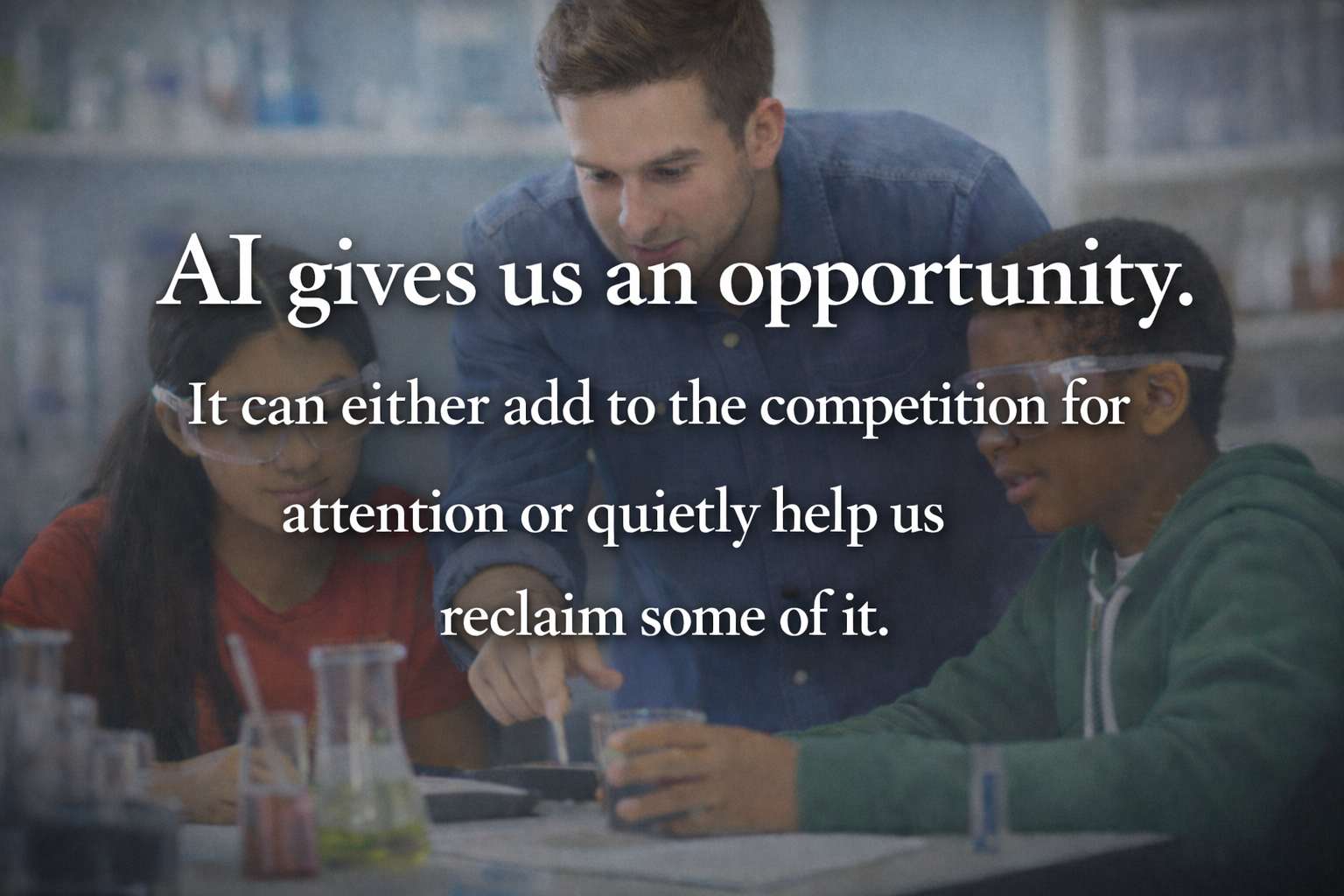
AI gives us an opportunity. It can either add to the competition for attention or quietly help us reclaim some of it. The design choice matters more than the technology itself.
If AI helps teachers intervene earlier, plan smarter, and give faster feedback, students spend more time talking, thinking, building, debating, and doing actual human stuff. Those activities have been known to occur off-screen.
The punchline is simple. AI does not have to mean more screen time. It can mean better screen time, which often translates to less of it. The machine handles the mechanical. The humans handle the human.
That feels like a future worth aiming at, even if it sounds a little insane on paper.
Need help developing lessons within a UDL framework? Want to incorporate AVID strategies into your next lesson? Try Lesson Optimizer by Sunriseclassroom.ai.